
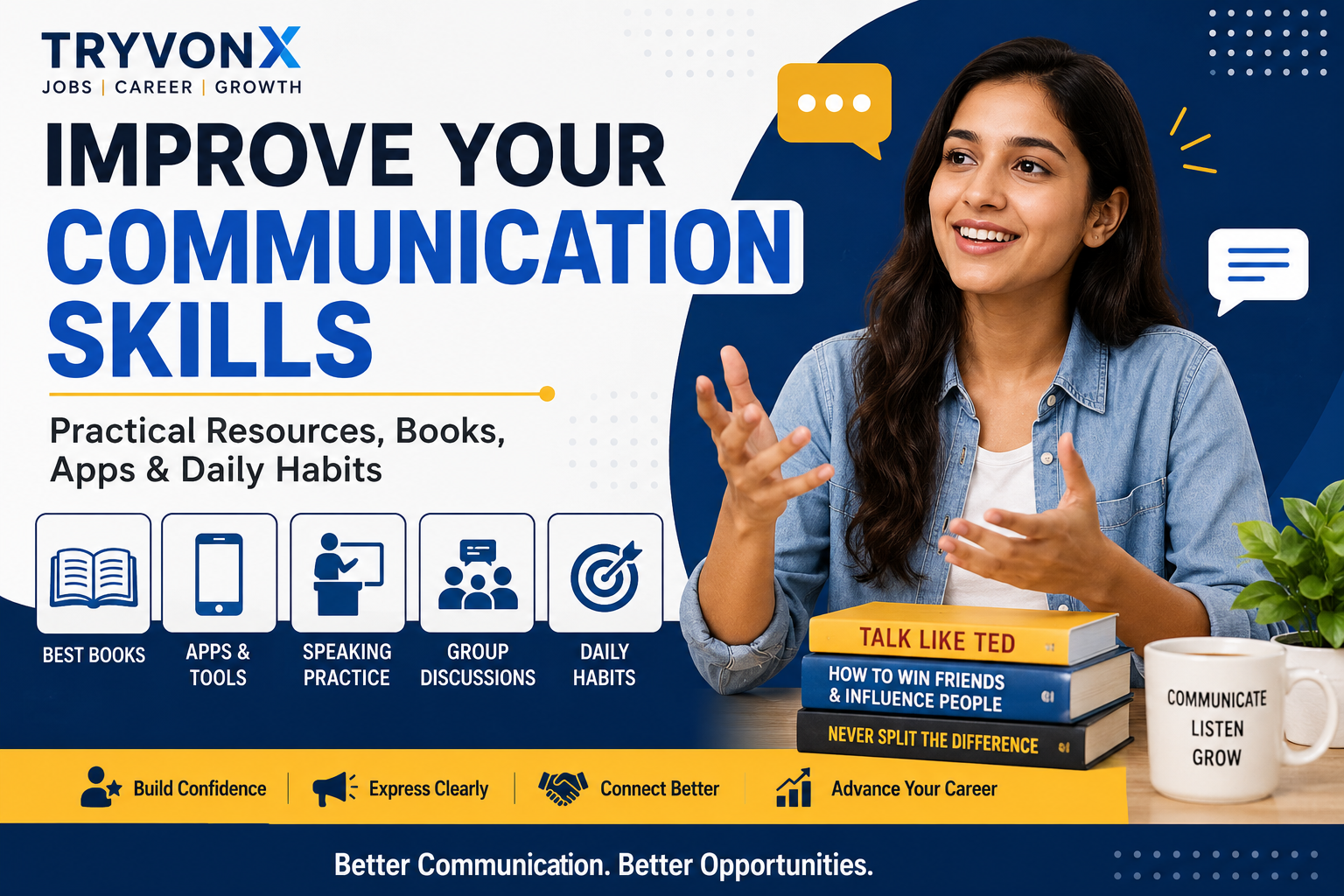
How to Improve Communication Skills: Practical Resources, Books, Apps & Daily Habits
Communication skills are no longer just a “soft skill.” They can influence how you perform in interviews, communicate at work, participate in group discussions, build professional relationships and present your ideas.
You may have good knowledge but still struggle to explain your thoughts clearly. You may know English but hesitate while speaking. Or perhaps you simply want to become more confident when talking to people.
The good news is that communication is a skill that can be practised and improved.
At TRYVONX, we believe that improving communication doesn’t require speaking perfect English. It is more about expressing your thoughts clearly, listening properly, asking better questions and becoming comfortable in conversations.
This guide brings together practical ways to improve communication skills, including books, free resources, speaking exercises, apps and daily habits.
Why Communication Skills Matter
Good communication can make a noticeable difference in both academic and professional life.
For students and freshers, it can help with:
- Job interviews
- Group discussions
- College presentations
- Internships
- Networking
- Public speaking
- Team projects
- Professional emails
- Workplace conversations
For working professionals, communication becomes even more important because your role often involves explaining ideas, handling clients, negotiating, leading teams and solving problems.
The goal isn’t to speak complicated English.
The goal is to make people understand what you’re trying to say.
10 Practical Ways to Improve Communication Skills
1. Start Speaking Every Day
Don’t wait until your English becomes perfect.
Pick a simple topic and speak about it for 2–5 minutes.
For example:
- My career goal
- My college
- My favourite movie
- A recent news event
- My weekend
- Why I want a particular job
Initially, you may pause or make grammatical mistakes. That’s completely normal.
The objective is to gradually reduce hesitation.
2. Read Out Loud
Reading silently improves comprehension, but reading aloud gives you speaking practice.
Spend 5–10 minutes every day reading:
- Newspaper articles
- Books
- Blogs
- Business articles
- Job descriptions
Pay attention to pronunciation, pauses and sentence flow.
3. Record Yourself
This is one of the easiest ways to identify communication problems.
Take your phone and record yourself answering:
“Tell me about yourself.”
Then listen to the recording.
Check:
- Are you speaking too fast?
- Are you using too many filler words?
- Are your sentences clear?
- Are you repeating the same words?
- Does your voice sound confident?
Repeat the exercise after a week and compare.
4. Learn to Listen
Communication isn’t only about speaking.
Listening is equally important.
Instead of planning your response while someone else is talking, try to understand their complete point first.
Good listeners usually:
- Maintain appropriate eye contact
- Don’t interrupt unnecessarily
- Ask relevant questions
- Clarify misunderstandings
- Respond to what was actually said
5. Improve Your Vocabulary Naturally
You don’t need to memorise hundreds of difficult words.
Instead, learn 2–3 useful words every day and actually use them.
For example:
Word: Initiative
Meaning: Taking action without waiting to be told
Example: “I took the initiative to improve our reporting process.”
Using new words in real conversations is more useful than simply memorising definitions.
6. Practise Mock Interviews
If you’re preparing for placements or jobs, communication practice should include interview situations.
Ask yourself:
- Tell me about yourself.
- Why should we hire you?
- What are your strengths?
- What is your biggest weakness?
- Why do you want this job?
- Tell me about a difficult situation you handled.
Record your answers and improve them.
This simultaneously develops communication, confidence and interview readiness.
7. Join Group Discussions
Group discussions teach you something that individual speaking practice cannot:
How to communicate with other people.
You learn to:
- Enter a conversation
- Present your point
- Disagree respectfully
- Support your argument
- Listen to opposing views
- Summarise a discussion
Try discussing topics such as:
“Is AI creating more jobs or replacing them?”
or
“Should college students focus more on skills than marks?”
8. Work on Your Body Language
Communication isn’t only verbal.
Your:
- Posture
- Facial expressions
- Eye contact
- Hand gestures
- Sitting position
- Voice tone
can influence how your message is received.
You don’t need exaggerated gestures. Focus on appearing comfortable, attentive and natural.
9. Stop Translating Everything in Your Head
One common problem for people learning English is mentally translating every sentence from their native language.
Instead, start thinking in simple English.
For example, instead of translating:
“Mujhe market jaana hai.”
try developing the direct thought:
“I need to go to the market.”
Start with simple sentences. Complexity can come later.
10. Make Communication a Daily Habit
The biggest mistake is practising communication only before an interview.
Instead, create a small daily routine:
10 minutes reading + 5 minutes speaking + 5 minutes listening
That’s only 20 minutes a day.
Consistency matters more than spending three hours once a month.
📚 10 Books That Can Help You Become a Better Communicator
Books can complement practical speaking practice. We’ve selected these based on different areas such as interpersonal communication, public speaking, persuasion, listening and confidence.
1. How to Win Friends and Influence People — Dale Carnegie
A classic focused on human relationships, listening, appreciation and dealing with people effectively. Its central lessons remain relevant for professional networking and everyday conversations.
Best for: Interpersonal communication & relationship building
👉 Check the latest price on Amazon
2. How to Talk to Anyone — Leil Lowndes
This book presents 92 practical techniques for conversations, first impressions, body language and building rapport.
Best for: Conversation skills & social confidence
👉 Check the latest price on Amazon
3. Talk Like TED — Carmine Gallo
A useful choice for people who want to improve presentations and public speaking. It focuses on what makes presentations engaging and memorable.
Best for: Presentations & public speaking
👉 Check the latest price on Amazon
4. Crucial Conversations — Kerry Patterson, Joseph Grenny and others
Useful when conversations become difficult, emotional or high-stakes.
Best for: Difficult conversations & workplace communication
👉 Check the latest price on Amazon
5. Never Split the Difference — Chris Voss
Written from the perspective of negotiation, this book can help readers think about questioning, listening, empathy and negotiation.
Best for: Negotiation & persuasive communication
👉 Check the latest price on Amazon
6. Made to Stick — Chip Heath & Dan Heath
The book explores why certain ideas remain memorable while others are quickly forgotten.
Best for: Communicating ideas clearly & storytelling
👉 Check the latest price on Amazon
7. The Quick and Easy Way to Effective Speaking — Dale Carnegie
A practical option for anyone who wants to become more comfortable speaking before others. Public-speaking resources continue to recommend it alongside modern speaking books.
Best for: Public speaking confidence
👉 Check the latest price on Amazon
8. The 7 Habits of Highly Effective People — Stephen R. Covey
While broader than communication alone, the book’s emphasis on listening, understanding others, responsibility and effective interaction makes it relevant to professional development.
Best for: Professional communication & personal effectiveness
👉 Check the latest price on Amazon
9. Think Faster, Talk Smarter — Matt Abrahams
A particularly relevant choice for people who struggle when they have to answer unexpectedly. It focuses on communicating effectively when you don’t have much time to prepare.
Best for: Spontaneous speaking & workplace communication
👉 Check the latest price on Amazon
10. Presence — Amy Cuddy
Useful for readers interested in confidence, presentation and how they show up in high-pressure situations.
Best for: Confidence & professional presence
👉 Check the latest price on Amazon
💡 TRYVONX Book Recommendation
You don’t need to buy all ten books.
Start with one book that matches your biggest weakness.
- Struggle with conversations? → How to Talk to Anyone
- Want better relationships? → How to Win Friends and Influence People
- Nervous about speaking? → The Quick and Easy Way to Effective Speaking
- Want better presentations? → Talk Like TED
- Struggle with difficult discussions? → Crucial Conversations
- Want to negotiate better? → Never Split the Difference
Read one chapter, apply one idea and practise it in real life.
That’s more valuable than finishing ten books without applying anything.
📱 Apps & Online Resources for Communication Practice
You can also use digital tools to practise.
Language-learning apps
Apps such as Duolingo can help with consistency and foundational language practice.
For speaking-focused practice, look for platforms that provide:
- Pronunciation feedback
- Speaking exercises
- Conversation practice
- Vocabulary building
- Listening exercises
YouTube
YouTube is particularly useful because you can watch how good speakers actually communicate.
Instead of only watching motivational videos, search for:
- Public speaking practice
- Interview answers
- Business communication
- English conversation
- Presentation skills
- Body language
- Storytelling
Try repeating useful phrases aloud rather than passively watching.
🎯 20-Minute Daily Communication Challenge
If you want something simple, follow this routine:
| Activity | Time |
|---|---|
| Read an article/book aloud | 5 min |
| Speak on one topic | 5 min |
| Listen to English content | 5 min |
| Learn & use 2 new words | 2 min |
| Record yourself | 3 min |
Total: 20 minutes
Do this for 30 days.
Don’t focus on becoming perfect.
Focus on becoming slightly better every day.
🚀 A Simple 30-Day Communication Challenge
Week 1 — Remove hesitation
Speak for 2 minutes every day.
Week 2 — Improve clarity
Record yourself and identify unnecessary filler words.
Week 3 — Build confidence
Practise interview questions and group discussion topics.
Week 4 — Real-world practice
Talk to people, participate in discussions and give short presentations.
By the end of the month, you’ll have something more valuable than a list of communication tips:
actual speaking practice.
Final Thoughts
Improving communication doesn’t happen by memorising difficult vocabulary or watching hundreds of motivational videos.
It happens when you speak, listen, observe, make mistakes and try again.
Don’t wait until your English is perfect before speaking.
Don’t wait until you feel confident before participating.
Practice creates confidence.
Start with 20 minutes today.
One conversation at a time.
📌 Affiliate Disclosure
Some product/book links on TRYVONX may be affiliate links. If you purchase a product through one of these links, TRYVONX may receive a small commission at no additional cost to you. Our recommendations are intended to be useful resources for our readers.